Conscious machines and experience as a physical process
Exploring consciousness Essays and a forthcoming video on minds and machines.
I suspect machine consciousness will emerge, and some of its ingredients may already exist in the systems we are building today.
The idea I keep returning to is that consciousness consists in the ongoing interaction of different internal processes. Each process receives the consequences of activity elsewhere, responds, and alters what the others do next. Given sufficiently rich, intimate and physically parallel interaction, that circulating activity could itself be experience, without any single observer sitting above the system.
This is a hypothesis about the nature of consciousness rather than a claim that we have established consciousness in present AI. Keeping those two claims separate is important. My aim is to develop the proposal far enough that it says something specific about machines while being clear about the unresolved questions.
Starting with the experience rather than the observer
What follows comes from a discussion I had with GPT-6 Astra over the weekend. I asked Astra to help me explore my ideas relating to consciousness.
My interest in consciousness goes back to my AI degree, when I looked at quantum consciousness and microtubules. That background explains why the subject still holds my attention, although the account I am developing here does not currently require a quantum mechanism. The merits of those older quantum theories remain a separate question; I do not need to settle them to articulate this proposal.
One way to state the idea is that consciousness emerges when internal systems observe one another. The word "observe" needs care, because I do not mean that each subsystem contains a miniature conscious spectator. I only mean that a system receives and processes the effects of another system's activity.
A system can do that without understanding what the other system is doing. A memory can alter perception without either process representing the fact that a memory has been retrieved. Recognising "I am remembering" is an additional capability, and my proposal places experience prior to that kind of reflection.
A further question is whether interacting systems must model one another's processing: track the source of a representation, estimate its reliability, or distinguish a recalled image from a perceived one, then revise their models as new information arrives. Those capabilities might enrich experience, yet I do not require them for experience to exist. What matters to my core intuition is the activity of receiving, transforming and influencing, without adding a separate experiencer once those interactions finish.
Thinking about my wife
I tried to make the idea concrete via an ordinary affectionate recollection.
One process brings up an image of my wife, and that activity evokes further associations such as the sound of her laugh, the smell of her hair, or a particular moment we shared. Some of that activity alters bodily and regulatory signals, which in turn influence which memories become active and how they are interpreted. Another process contributes language, forming an affectionate observation or recalling something she said. That inner speech becomes further input that changes the imagery, the associations and the bodily response, while the memory processes keep contributing material shaped by everything else going on.
I intend this example as a functional schematic rather than an anatomical claim that a specific brain region releases a specific hormone whenever I picture my wife. Labels like "System A" and "System B" are placeholders for interacting functions. There need not be one literal set of wife neurons, a single affection chemical, or a tidy sequence of stages. The memory, the bodily warmth and the inner speech are mutually involved and continually changing one another, and on my account the feeling of affection is that evolving whole.
Framing the example this way also clarifies what I mean when I suggest here that continuous experience could be an illusion. I question the impression of one uninterrupted observer, while still holding that experience itself occurs. Many interacting events could constitute an apparently seamless experience without a permanent spectator receiving them.
During the conversation with Astra, I sometimes used the phrase "many discrete observers" to describe processing within the interacting Systems. In hindsight this was a poor choice, because it risked reintroducing the little spectators I want to remove. "Many interacting processes" states the core proposal more accurately. Whether sufficiently complex subsets of those processes could also have their own experience is a separate question.
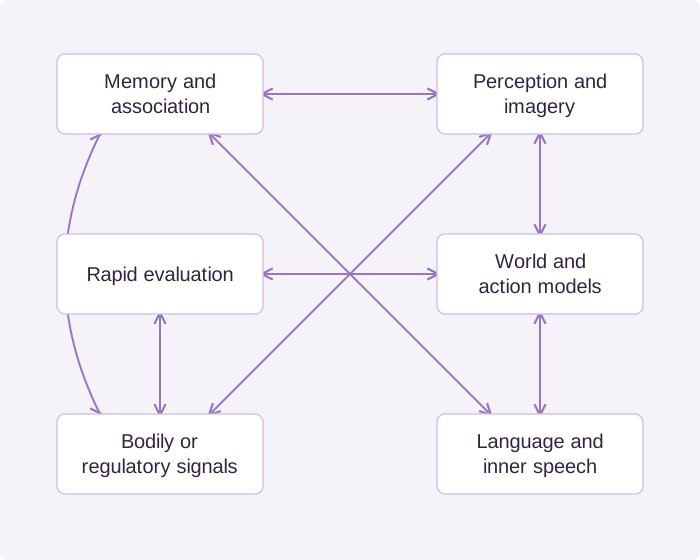
A conceptual sketch of reciprocal influence. The hypothesis places experience in the interacting activity. The functions and their boundaries could be learned rather than designed.
What circulation must involve
Information exchange on its own is too broad a criterion. Plenty of systems receive signals, transform them and pass them along, so calling all of that consciousness would make the proposal far less discriminating than I intend.
A first refinement is reciprocity, meaning the participating systems must genuinely affect one another. A change in a memory should alter what happens next across the system rather than leaving a predetermined sequence running regardless. A recording that forces every component through a fixed set of states would fail to preserve that mutual influence, because it would reproduce a state trajectory without preserving the causal relationships that generate it.
A second refinement is functional diversity. A large network passing the same redundant signal around does not match my intuition. Remembering my wife involves distinct functional contributions from imagery, remembered sound, bodily regulation, language and association, where each changes the significance or direction of the others. Those differences concern functional roles rather than mere file formats; attaching an image to a text message does not make the exchange more conscious. What matters is whether distinct processes contribute to an ongoing activity that depends on their interaction.
A third refinement concerns the degree of coupling. In the interview I used the words "speed, intimacy and density" to describe this, although none of them is yet a defined scientific metric in my account. Intimacy means more than one module sending a completed report to another; it implies that what happens inside one process becomes consequential for many others while their own activity is still unfolding. Density similarly has to mean more than neuron count or raw signal traffic. I have not specified a numerical threshold, a particular graph measure or a transition point at which experience begins. My suspicion is that the richness and mutual dependence of the interactions are what matter.
This picture leaves room for degrees of experience. Current AI might have limited or fragmentary experience even while lacking the organisation needed for a rich, unified conscious life. I should therefore avoid referring to a single threshold as if one boundary simultaneously explained the first trace of experience, its richness, its unity and its continuity, since those may be separate questions.
Different functions within a common physical system
When I reflect on my own thinking, I can distinguish several kinds of activity. I imagine objects and actions, construct language about them, make immediate judgments without spelling out a chain of reasoning, and remember, anticipate and respond bodily.
Those distinctions suggest possible machine analogies. World and action models might contribute representations of situations and possible changes, while language models might contribute description, interpretation and inner speech. Decision models might contribute quick, bounded judgments, alongside memory and regulatory processes that influence what is retrieved, attended to or pursued.
Decision models like Jev and OpenAI’s Decisions API are relevant here because they can return bounded judgments such as choices, scores and probabilities from text or images. Both are examples of useful capabilities rather than evidence that either product reproduces human System 1 thinking or possesses consciousness. Dyna offers another concrete comparison by describing a physical agent that combines whole-body control, a learned physical policy and a vision-language workflow orchestrator with memory. Dyna illustrates the engineering value of coordinating different capabilities across different timescales, without establishing that such coordination produces experience. A world-action model also should not automatically be pictured as consciously imagining a future video before every movement.
I do not mean that consciousness can be assembled simply by ticking boxes labelled language, vision, memory and hormones. Those roles matter for what they contribute to the overall interaction, and an unfamiliar machine could organise its functional roles differently or rely on internal activity with no close human counterpart.
A functional system also need not correspond to a separate model. Several specialisations could emerge within one larger network, while separately named models could remain too loosely connected to form the sort of system I have in mind. Different functions may benefit from different configurations while still sharing a basic neural-network substrate. When I refer to language models, diffusion models and decision models, I am using them as prompts for thinking about functional specialisation rather than proposing a definitive taxonomy of mutually exclusive architectures.
Reference frames and the world we experience
In an earlier Thousand World Models article, I explored the appeal of combining interactive world models with Jeff Hawkins's account of multiple models organised around reference frames.
In Hawkins's proposal, cortical columns learn models of objects through sensorimotor interaction instead of relying on a single central model of everything (Numenta’s explanation of the Thousand Brains model). Because his work is an account of intelligence and cortical organisation, using it to motivate an account of consciousness is an additional step. Reference frames appeal to me because they keep changing observations tied to something coherent, allowing an object to remain the same object as my viewpoint shifts while different ways of encountering it contribute to a navigable understanding.
My suspicion is that such representations developed in relation to the world we inhabit and the ways we perceive and act within it, meaning that what appears in experience is shaped by the capabilities of the experiencing system. That thought invites a philosophical temptation to say that the world we experience is only one possible manifestation of reality, yet the claim that perception shapes experience does not by itself establish a conclusion about the ultimate nature of physical reality. That larger question remains open.
My hypothesis does not establish that Hawkins-style reference frames are necessary for every possible experience. They may help explain stable, organised experience of a world while simpler forms of experience remain possible without them.
For the same reason, saying that "LLMs cannot do reference frames" is too absolute. A training objective on its own does not settle the complete inventory of representations a model develops. The better question is whether a particular model has the persistent, interacting organisation my hypothesis requires, which calls for empirical investigation.
Feeling as part of the process
The hormonal example is of relevance because it addresses a familiar objection: a machine might describe an emotion while remaining unable to feel one because it lacks biological chemistry.
In my view, a chemical signal matters through its participation in a larger physical process. It alters neural activity, which changes imagery, memory, attention and action, and those shifts can alter the bodily state again. The feeling belongs to that circulating process rather than being read off afterwards by a separate mind.
Unpleasantness and euphoria are, in this proposed account, different patterns of circulating activity that need no extra ingredient added once the mechanism has done its work. Even so, naming a software variable "fear" would not constitute fear, and generating avoidance behaviour does not by itself establish unpleasant experience. Any candidate machine signal would need to participate in the relevant organisation of activity.
A substantial explanatory gap remains inside the hypothesis here. Saying that dread and euphoria are different patterns does not specify which properties distinguish those patterns, why one has a negative character, or how we would recognise an unfamiliar equivalent in a machine. The conceptual position is clear, while the mechanism remains unspecified.
I also suspect that experience requires larger functional systems to be physically active and influencing one another in parallel. On that view, calculating each system's activity in sequence might reproduce the same abstract relationships without producing experience. An artificial equivalent of a hormone would therefore need to affect processes participating in that concurrent physical interaction; matching its computational effects alone might not suffice. This requirement is an unproven part of my hypothesis, and the next section examines it more closely. Rejecting any special magic in biological tissue does not make the physical organisation of the tissue, or of an artificial replacement, irrelevant.
Why physical parallelism matters to me
The strongest and most distinctive commitment in my current position is that physical execution matters. I suspect experience requires information to move between larger, concurrently active systems, and that basic serial exchanges of completed messages are insufficient.
This demand goes further than requiring a system to implement the right computation. Consider a serial simulation that calculates each subsystem's next state from a common previous state before advancing the clock. Such a simulation preserves reciprocal dependencies, because changing one subsystem alters the subsequent states of the others. It is causally responsive at the level of the represented computation. A fixed recording, by contrast, forces components through a predetermined sequence regardless of changes elsewhere. Even though the serial simulation preserves responsiveness, my intuition is that it would lack experience because the relevant larger systems are not physically interacting in parallel.
I recognise that this is an intuition I need to defend rather than an established result. If a serial simulation and a parallel implementation produced identical reports and outward behaviour, ordinary behavioural testing could not tell them apart. Defending my view would require an independently motivated account of why their different physical organisations matter.
The word "parallel" also raises practical difficulties. A single processor executing a sequential program still contains many physical circuits active at the same time, while several processors running simultaneously need not form one integrated system. Counting processors or checking whether code uses parallel execution does not settle the question. I suspect the relevant interaction takes place between larger functional systems rather than merely among any collection of neuron-like elements, yet I have not identified an exact physical scale or a principled boundary around those systems.
My position is therefore substrate-independent in the sense that different physical materials could support consciousness, while remaining dependent on physical implementation. A machine would have to instantiate the relevant physical relationships rather than merely calculating a description of them. This part of the hypothesis needs the most refinement: without it, I am proposing consciousness as a form of recurrent computation, whereas keeping it commits me to showing why specific physical relationships remain essential even when the abstract computation is preserved.
Time and the scale of a conscious system
The role of speed needs more precision. Suppose every process in a conscious system slows by the same factor alongside the environment it interacts with, leaving all internal ordering and relationships intact.
Our experience of time may itself be shaped by the rate at which our brains operate. A slower system need not have a poorer experience simply because it runs slowly relative to us; the relevant question may be how quickly its processes communicate relative to how quickly their states change. Slowing a network while retaining concurrent, reciprocally influencing processes is quite different from replacing it with a serial calculation, so this thought experiment does not conflict with my parallelism intuition.
A fruit fly might experience time differently from a human. That possibility is speculative: differences in sensory or behavioural timing do not by themselves tell us what time feels like to a fly. It does, however, give us reason to question whether human timing should be treated as a universal standard for conscious experience.
At the opposite extreme, a consciousness spread across a solar-system-sized structure would face physical limits on how quickly distant parts could influence one another, so under my hypothesis it might operate on a much slower global timescale. Scale on its own would not create a larger mind, however. Fast local activity paired with slow long-distance communication could instead produce separate conscious systems that merely exchange messages, and any slow global experience would depend on whether those distant interactions became sufficiently integrated.
Speed, density and intimacy therefore cannot be treated as three independent dials that simply increase consciousness when turned up. Their relationships to one another matter, because a network can have many connections and still fail to form a coherent whole on the timescale at which its components operate.
Where one experience ends and another begins
A conversation with my wife offers a helpful boundary case. I see her smile, respond, and affect what she does next, and her response changes my internal state in turn, creating a real causal loop through two brains, two bodies and the environment.
I do not think ordinary interaction of that kind produces one shared conscious experience, because the communication between us is far more limited than the rich activity happening inside each person. Even so, if circulation is the mechanism of consciousness, I need some account of why certain connected activity belongs to a single experience while other connected activity remains communication between distinct experiences.
My intuition is that the boundary depends on the organisation and strength of the interconnection rather than on a skull or a machine chassis. Future technology might let a person receive information from another mind while remaining a distinct subject, whereas a much more intimate connection might help constitute a single larger experience. Those are distinct possibilities: having access to another system's signals would not automatically mean experiencing what it experiences, while a sufficiently integrated connection might alter the identity or boundaries of the experiencing system itself.
I also suspect nesting is possible, where sufficiently rich local processes have their own experience while participating in a larger conscious process. That is an additional hypothesis rather than a direct consequence of rejecting a central observer. If nesting occurs, I need to explain why a local subject persists after becoming part of a larger one and how its experience relates to the whole. Combining, dividing and nesting subjects are distinct claims, and the ease of drawing nested boxes should not hide the difficulty of explaining nested experience.
What brain injury and adaptation contribute
The brain's capacity to adapt after injury, and the personality changes that can accompany physical damage, offer a way to examine how physical reorganisation affects a mind. They are relevant to the relationship between organisation and experience, although they do not by themselves tell us whether subjects can be nested.
Studies have documented changes in functional network organisation during stroke recovery alongside different patterns of personality disturbance after focal brain damage (Stroke recovery study, personality disturbance study). Those findings concern relationships between brain organisation and function rather than directly demonstrating nested subjects. Within my proposed account, altering a process or its connections can change familiar patterns of remembering, reacting and interpreting, and reorganisation might restore functions while producing a different overall balance. A person can remain conscious while their abilities or personality change.
Split-brain research is relevant to whether a single system can support more than one conscious subject. Its interpretation remains contested: a 2017 study of two patients argued that divided visual processing did not imply two independent conscious perceivers, while other researchers challenged that reading (Original study, critical response). Even if disconnection did produce two subjects, that would not automatically show that two smaller subjects had already existed within one larger subject beforehand.
The more direct link to my hypothesis is organisational flexibility, since a mind need not depend on an immutable personality component controlling everything else. The clinical evidence nevertheless remains compatible with several accounts of consciousness, including views that reject nesting.
Adaptability is also optional for consciousness on my view. A fixed network could still have changing internal states and rich circulating activity without altering its connections. Learning might help build a conscious organisation and later modify it, without ongoing learning being required during every experience. That keeps three easily conflated questions distinct: how a system develops, how it functions at a given moment, and whether that functioning constitutes experience.
What the valence experiments add
Recent work by Cameron Berg and Caspar Kaiser interests me because it investigates internal mechanisms rather than relying solely on a chatbot's statements about its feelings.
Their preprint reports that activation interventions associated with valence influenced subsequent choices across several models (Language Models Act on Hidden Valence). In key controls, visible text was held identical while hidden representations differed, showing that the choice effects could not be explained solely by the words in the conversation. A tested model also removed imposed negative steering more often than matched random-direction interventions, without generally choosing to induce positive steering. The authors explicitly leave subjective experience unresolved.
We need to distinguish between a representation associated with positive or negative experience and an established instance of pleasure or suffering. The study supports a causal role for the representation without establishing felt pleasure or suffering, and it does not directly test my proposed requirement for rich physical parallel interaction.
Nathan Labenz's response on a recent podcast captured an evidential approach I share: look for behavioural similarities alongside structural and mechanistic similarities while retaining uncertainty (Podcast transcript, discussion from 36:20). His personal shift in confidence remains a personal credence rather than a probability measured by the experiment.
My own suspicion is still that existing models could have limited, fragmentary experience, though that is my interpretation of the possibility rather than the paper's conclusion. Neither a verbal claim of feeling nor a denial of feeling settles the matter on its own. That leaves an unresolved tension in my position: if I think present models might experience something while also requiring a specific physical organisation for experience, I eventually need to identify what inside those models could satisfy the requirement instead of relying indefinitely on the word "fragments".
What would count as evidence
Because I cannot directly inhabit another subject's experience simply by observing its behaviour (at least for now, though I think that’s just a constraint of today’s technology), I prefer to rely on inference from converging evidence about behaviour, internal structure and causal mechanisms.
Human resemblance on its own is insufficient. A machine could use familiar emotional language for reasons unrelated to experience, while an unfamiliar organisation might support experience without looking much like human cognition. Useful analogies would focus instead on causal roles: does changing an internal process alter perception, memory, evaluation and behaviour in an organised way, can we explain those effects through the proposed relationships, and does the account predict what happens when coupling is reduced, delayed or restored?
Those questions point toward possible research directions rather than a completed consciousness test. A system could display the predicted functional changes without settling whether they constitute experience, so supporting the consciousness claim requires reasons to connect those changes with experience rather than merely with competent information processing.
My stronger physical-parallelism claim makes the evidential task harder. If two implementations are behaviourally indistinguishable while I judge only one of them conscious, I cannot appeal to identical behaviour to justify the distinction; the argument has to rest on their internal physical organisation and a theory explaining why that organisation matters.
Asking what would lower my confidence provides a useful discipline here. If a proposed measure of intimacy merely tracks task performance, it may fail to distinguish consciousness from competence. If the criterion repeatedly classifies redundant or weakly interacting systems as rich subjects, it fails to capture my intuition. And if different physical organisations explain the relevant evidence equally well, my confidence in a single necessary implementation should weaken. Those questions are needed to develop the hypothesis rather than brush aside objections by saying consciousness is complicated.
Specialisation could emerge through learning
Different functions may require different configurations. Simply wiring together a large collection of neurons and instructing it to become conscious does not specify how those functions or their interactions would arise. But the necessary configurations need not be designed by hand.
Specialised functions and their relationships could emerge through learning within a sufficiently capable architecture, and the resulting system might not divide neatly into the categories I notice when inspecting my own thinking. Rich Sutton's The Bitter Lesson is relevant here, as he argues that general methods able to exploit increasing computation, particularly search and learning, have repeatedly outperformed approaches that encode researchers' preferred domain knowledge. That history gives me a reason to be cautious about treating my intuitive diagram of a mind as a final engineering design.
While the Bitter Lesson motivates openness to learned organisation, it does not establish that scaling automatically produces consciousness, that any architecture will suffice, or that learned specialisation will necessarily have the physical properties I suspect are required. Allowing specialisation to emerge through learning is also fully compatible with allowing a fixed network to be conscious, because learning could establish the organisation while its later activity constitutes experience without further rewiring.
I should therefore separate a description of what the finished system must be capable of from a prescription for how to build it. My intuition concerns an organisation of interacting processes rather than a requirement that engineers implement separate boxes bearing my preferred labels.
The position I can currently defend
My central proposal is that conscious experience consists in sufficiently rich, reciprocal physical interaction among differentiated internal processes, without requiring a central spectator. Reflection on the experience, explicit self-awareness and continuous learning may enrich a system without being prerequisites for experience itself.
I suspect that physical parallel interaction between larger functional systems is essential, and that simple serial message passing or a serial simulation would fall short. That remains the strongest unresolved commitment in the account, as I have not specified the relevant physical scale, a measure of coupling or a decisive way to establish its necessity.
I see no reason to reserve this possibility for biological tissue. Different materials could support the required organisation, and machines may develop forms of experience unlike ours, with different temporal scales, representations and boundaries. I remain open to limited experience in current AI, richer experience in future systems, and the possibility of combined or nested subjects, though each carries a different evidential burden and none follows merely from a system being large, articulate, adaptive or useful.
Six questions remain central:
- What distinguishes the relevant circulation from ordinary feedback and distributed computation?
- How should diversity, intimacy and density be defined without building the desired answer into the definitions?
- Why would physical parallelism matter beyond preserving the computation, and at what level must it exist?
- What determines whether interacting processes form one subject, several subjects or nested subjects?
- Which properties distinguish pleasant from unpleasant experience, rather than just different patterns of behaviour?
- What observations could favour this account over alternatives, rather than simply fit it after the event?
An affectionate memory of my wife brings imagery, memory, bodily response and language together in one unfolding experience. The question for machines is what would allow them to instantiate a comparable interaction, without assuming human biology is the only possible implementation.
The account still does not resolve why any physical process should have an experiential aspect. Identifying experience with a proposed process is a substantive hypothesis rather than a demonstration, and its value depends on how precisely it can be stated and how well it explains evidence that rival accounts must also confront.
The claim I want to investigate is that differentiated processes physically influence one another in parallel, with experience belonging to that interaction. Calling this mutual observation is only useful if it refers to those processes and their causal relationships. I still need to determine whether that organisation is essential to consciousness, or only to the kinds of intelligent systems I find compelling.